“Coffee spikes cortisol” gets repeated online as settled fact, usually alongside advice to delay your first cup by 90 minutes. The real research is more specific and more interesting than either the scare version or the dismissal: caffeine does reliably raise cortisol in people who have not had any recently, but daily drinkers develop measurable, if incomplete, tolerance within days, and at least one careful trial found caffeinated coffee does not so much spike cortisol as stop it from falling the way it normally would after a meal. This site’s own coffee and anxiety breakdown already covers how caffeine interacts with the body’s stress signaling at the receptor level; this page covers the cortisol-specific numbers, including where the popular “wait before your morning coffee” advice actually comes from and how far the evidence backs it up.
How caffeine actually raises cortisol: the ACTH pathway
Cortisol is not released directly by caffeine. It follows a signaling chain called the hypothalamic-pituitary-adrenal (HPA) axis: the hypothalamus releases corticotropin-releasing hormone, which tells the pituitary gland to release adrenocorticotropic hormone (ACTH), which tells the adrenal cortex to release cortisol. Caffeine’s blocking of adenosine receptors, the same mechanism this site’s anxiety piece covers for its effect on mood, is what triggers that chain at a high enough dose, functioning as a mild, repeatable activator of the same stress-response pathway a genuine stressor would use.
The clearest human data on how big that effect actually is comes from a 2005 double-blind, crossover trial in Psychosomatic Medicine. Lovallo and colleagues enrolled 96 healthy adults, 48 men and 48 women, across two research sites, and had each go through a full caffeine-abstinence period before receiving challenge doses of 250mg of caffeine at 9:00 a.m., 1:00 p.m., and 6:00 p.m. on a single test day, 750mg in total, roughly what this site’s own figures put at about 8 cups of filter coffee or 12 63mg espresso shots spread across a day. After abstinence, that dosing schedule produced what the authors call “a robust increase in cortisol across the test day” (p < .0001), confirming that caffeine is a genuine, statistically unambiguous cortisol trigger when the body has not adjusted to a regular intake.
Regular drinkers build tolerance, but not complete tolerance
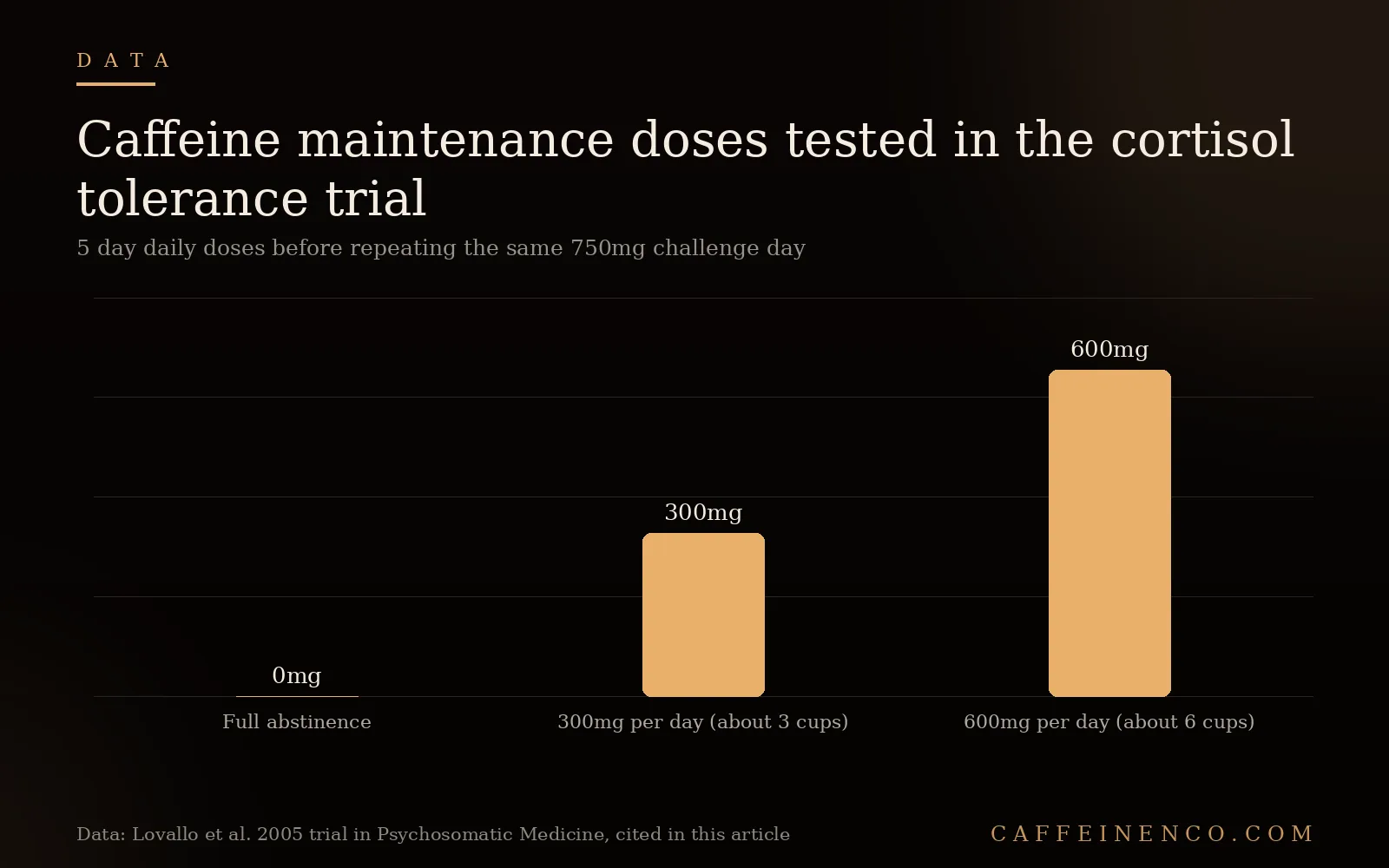
The same trial produced its most useful finding when it repeated the same 750mg challenge day after 5 days of daily maintenance dosing at either 300mg or 600mg per day, roughly 3 or 6 cups of filter coffee using this site’s own per-cup figure.
| Maintenance dose (5 days) | Cortisol response to the same 250mg x 3 challenge |
|---|---|
| 0mg (full abstinence) | Robust increase across the entire test day (p < .0001) |
| 300mg/day (about 3 cups) | Incomplete tolerance; still significantly elevated at 1:00 and 2:00 p.m. |
| 600mg/day (about 6 cups) | More complete tolerance; only rose significantly after the 1:00 p.m. dose, back near baseline by evening |
The counterintuitive part is that the higher maintenance dose produced more tolerance, not less. Lovallo’s team concluded that “cortisol responses to caffeine are reduced, but not eliminated, in healthy young men and women who consume caffeine on a daily basis,” a partial-tolerance finding rather than a complete one. A separate 2011 crossover trial in The Journal of Nutrition adds a genuinely useful nuance to what that tolerance looks like in practice. Gavrieli and colleagues gave 16 healthy men a standard breakfast alongside 200mL of either caffeinated coffee (3mg of caffeine per kilogram of body weight), decaffeinated coffee, or plain water, on three separate mornings. The caffeinated coffee did not push cortisol up above its starting point; instead, it prevented the normal post-breakfast decline in cortisol seen in the decaf and water conditions. In other words, for someone already in a caffeinated, well-fed morning state, “spike” may be the wrong word entirely. The more accurate one is “delay the drop.”
Under real stress, the picture gets murkier
Both studies above measured cortisol at rest or after a scheduled dose, not during an actual stressful event. A 2024 Psychosomatic Medicine study by Cole and colleagues tested that gap directly using the Trier Social Stress Test (TSST), a standardized public-speaking-and-mental-arithmetic task widely used to reliably trigger a real cortisol stress response in a lab. Across two separate samples, the first of 128 emerging adults randomly assigned to a control, intermediate, or explicitly negative-evaluative version of the test, and the second of 148 emerging adults randomly assigned to just a control or negative-evaluative version, the researchers found that habitual caffeine use, not same-day acute caffeine intake, predicted a heightened cortisol reactivity to the stress condition in both samples. Put plainly: people who regularly drink caffeine showed a bigger cortisol jump when genuinely stressed than people who do not, even though the tolerance research above shows habitual users have a blunted response to caffeine itself at rest.
That finding does not stand unchallenged. A 2024 BMC Psychology study by Ueno ran a similar design in 48 Japanese men, split evenly into no-coffee, low-coffee (1 to 3 cups a day), and high-coffee (4 or more cups a day) groups, using an online version of the same stress test. Subjective stress and cortisol both rose significantly after the test for everyone, but “there were no significant differences among the groups,” directly contradicting the heightened-reactivity pattern Cole’s team found. The two studies differ in ways that could plausibly explain the gap: Cole’s participants were younger US college-aged adults tested in person across two large samples, while Ueno’s were middle-aged Japanese men (mean age 46) tested through an online stress protocol, in a single smaller sample. Neither difference proves which finding generalizes further, and that is the honest state of this specific question right now: habitual caffeine use plausibly amplifies your cortisol response to real stress, but a same-sized contradicting study exists, and it has not been resolved by a larger follow-up yet.
The “wait 90 minutes for cortisol to fall” advice: what actually backs it

The recommendation to delay your first coffee by 60 to 90 minutes after waking, popularized largely through fitness and productivity media, rests on a real physiological fact and an unproven leap. The real fact, confirmed by Cleveland Clinic registered dietitian Anthony DiMarino, is that cortisol naturally rises after waking to promote alertness and typically peaks between about 7 and 8 a.m. before declining through the rest of the day, a pattern researchers call the cortisol awakening response. The leap is the claim that drinking caffeine during that natural peak is wasteful or harmful, and that waiting until the peak subsides produces a better outcome. Cleveland Clinic’s own reporting is direct about the gap between the two: it states plainly that “there’s no scientific evidence that supports a ‘best time’” to drink coffee, even as the same article goes on to suggest a window of roughly 9:30 to 11 a.m., reasoning that cortisol has started to dip by then, without citing a study that actually tested delayed against immediate coffee on any outcome.
That does not make the underlying biology fake. Cortisol really does peak in the morning, and caffeine really does interact with the same HPA axis that produces it, per the mechanism section above. What is missing is a controlled trial actually comparing people who wait 90 minutes against people who do not, on any measurable outcome like energy, focus, or long-term tolerance. Until that trial exists, the 90-minute rule is a reasonable-sounding hypothesis built from two true facts, not a proven recommendation.
Does the cortisol effect actually cause weight gain?
Search demand around this topic leans heavily toward “does coffee’s cortisol effect make you gain belly fat,” and the honest answer is that the studies above do not support a direct link at normal intake levels. Chronic, sustained cortisol elevation is genuinely associated with abdominal fat storage in the broader endocrinology literature, but every caffeine-specific study in this article describes an acute, time-limited rise, not a sustained one. Lovallo’s own data shows the effect fading to non-significant by evening even at a 600mg maintenance dose, and Gavrieli’s trial found the effect was a blunted decline rather than an outright spike in already-caffeinated, fed adults. No study cited here tested caffeine’s cortisol effect against actual long-term fat mass, so any claim connecting a normal coffee habit directly to belly fat through this pathway is reasoning several steps ahead of what has actually been measured. Mayo Clinic’s own general caffeine guidance keeps the goalposts where the evidence actually supports them: monitor total daily intake, capped around 400mg for most healthy adults, and watch for downstream effects like poor sleep, which has a far better-established connection to weight regulation than a same-day cortisol curve does.
Worked example: checking your own dose against the tolerance data
- Add up your normal daily caffeine total using this site’s own per-serving numbers: about 96mg per 8-ounce cup of filter coffee, about 63mg per espresso shot. Lovallo’s 300mg tolerance-tested dose works out to roughly 3 cups; the 600mg dose to roughly 6.
- Compare your total to the two tested maintenance levels above. If you are well under 300mg a day, you likely have less built-up tolerance than either study group, meaning a stronger-than-usual cup could produce a bigger cortisol response than it would for a heavier daily drinker.
- Note your last cup’s timing relative to any stressful event you have coming up, since Cole’s 2024 finding was specific to habitual users under an active stress test, not caffeine at rest. If a big presentation or exam is on the calendar, that is where the still-unresolved heightened-reactivity question actually matters most, not on an ordinary day.
- If you already wake up feeling wired before your first cup, per Cleveland Clinic’s cortisol awakening response explanation, that jitteriness is more likely your body’s own morning cortisol curve than the coffee, since caffeine has not been shown to reliably add much on top of an already-elevated stress hormone at that specific hour.
- If you want to cut your afternoon or evening caffeine load without giving up the ritual, a decaf coffee selection from 1st in Coffee removes most of the variable this article covers, or browse the same category on Amazon. This site’s own decaf caffeine content breakdown has the real per-cup range for planning around it.
- Track how you feel, not just the number. This site’s coffee before a workout piece covers the CYP1A2 gene that changes how fast people metabolize caffeine in the first place, which is a real, physiological reason two people on an identical dose can have different cortisol-adjacent experiences.
Common mistakes
Treating “coffee spikes cortisol” as a fixed, universal fact is the first mistake; Gavrieli’s trial found caffeinated coffee prevented a normal cortisol decline rather than causing an outright spike in already-fed, already-caffeinated adults, which is a meaningfully different mechanism than the word “spike” implies. Assuming daily drinkers get the same cortisol jolt as an occasional drinker is the second mistake; Lovallo’s tolerance data shows a 600mg daily habit blunts the response by evening, while a 300mg habit does not blunt it nearly as much, a genuinely counterintuitive, dose-dependent pattern. Assuming the “wait 90 minutes” rule is proven science is the third mistake; Cleveland Clinic states outright that no research has actually tested and confirmed a benefit to delaying coffee past the cortisol awakening response, even though the underlying cortisol-timing facts it is built on are real. Assuming the stress-reactivity question is settled is the fourth mistake; Cole’s 2024 finding of heightened reactivity in habitual users has a same-year, similarly designed study from Ueno finding no such difference, and nothing published since has resolved which pattern holds more broadly. Jumping from “cortisol” to “belly fat” is the fifth mistake; no study in this article measured long-term fat mass, and every measured cortisol effect here fades within hours, not the sustained elevation the fat-storage research actually describes.
Common questions
Does coffee really spike cortisol? It raises cortisol reliably in people without recent caffeine in their system, per a 96-person trial that found a statistically robust increase (p < .0001) after a caffeine-abstinence period. In already-caffeinated, fed adults, a separate trial found caffeine prevented cortisol from falling rather than pushing it up further, so “spike” is not always the most accurate description.
Do you build a tolerance to caffeine’s cortisol effect? Yes, but only partially. A 5-day trial found that a 300mg daily maintenance dose still produced a significantly elevated cortisol response in the afternoon, while a 600mg daily dose produced more complete tolerance, with cortisol back near baseline by evening.
Should I wait to drink coffee in the morning because of cortisol? The biology behind the advice is real (cortisol does peak around 7 to 8 a.m. and decline afterward), but Cleveland Clinic states plainly that no research has actually confirmed a benefit to delaying your first cup until that peak subsides. Treat it as an untested hypothesis, not a settled recommendation.
Does coffee’s effect on cortisol cause belly fat? The evidence does not support that specific claim at normal intake. Every cortisol rise measured in the caffeine research cited here is acute and fades within hours, not the sustained elevation that is actually linked to abdominal fat storage in the broader endocrinology literature, and no study here tested caffeine’s cortisol effect against long-term fat mass directly.
Does caffeine make your cortisol response to stress worse? The evidence is genuinely mixed. A 2024 study of 128 and 148 emerging adults found habitual caffeine users had a heightened cortisol response to a standardized lab stress test, while a same-year study of 48 Japanese men found no significant difference by coffee-drinking habit at all.
How much caffeine actually raises cortisol? The most detailed trial used 250mg doses, three times in one day, and found a robust cortisol increase in people without a recent caffeine habit. Using this site’s own per-serving figures, that is roughly 2.6 cups of filter coffee or 4 espresso shots per dose, well above a single normal-sized cup.
For more sourced breakdowns like this one, delivered weekly, subscribe to The Sunday Pour.
Sources & data
- Psychosomatic Medicine, via PMC: Lovallo et al., Caffeine Stimulation of Cortisol Secretion Across the Waking Hours in Relation to Caffeine Intake Levels
- Psychosomatic Medicine: Cole et al., Habitual Caffeine Use Is Associated With Heightened Cortisol Reactivity to Lab-Based Stress in Two Samples
- BMC Psychology: Ueno, No Significant Difference in Salivary Cortisol Response on the Trier Social Stress Test-Online Based on Coffee Consumption Habits
- The Journal of Nutrition: Gavrieli et al., Caffeinated Coffee Does Not Acutely Affect Energy Intake, Appetite, or Inflammation but Prevents Serum Cortisol Concentrations From Falling in Healthy Men
- Cleveland Clinic: When Is the Best Time to Drink Coffee?
- Mayo Clinic: Caffeine, How Much Is Too Much?