
This site’s own troubleshooting posts already lean on descaling as a fallback fix. The guide to why coffee tastes bitter calls for a “monthly descale” without saying how to actually run one. The burnt-taste guide puts a vinegar descaling cycle last on its checklist, after beans, water, and timing, a fix that still works but is only safe on machines without an aluminum boiler, per the citric acid section below. The crema guide says a descale is “worth doing” before blaming the beans or grind. None of the three walks through the process itself, and none addresses the question that actually drives most of the search traffic on this topic: should that descale use vinegar, citric acid, or a manufacturer’s own solution, and how often does it really need to happen. Five independently published sources, covering general prosumer machines, reservoir-style home machines, and the two most common consumer brands, give this site enough to answer both questions properly for the first time.
How often you actually need to descale

The honest answer is that there is no single fixed interval; every sourced guide here ties frequency to water hardness rather than a flat calendar. Alliance Chemical gives the most granular breakdown, built around parts-per-million (ppm) hardness readings: soft water needs a descale roughly every 3 months, medium hardness every 1 to 2 months, and hard water, defined there as above 180ppm, every 3 to 4 weeks. Home Grounds lands inside that same range from the opposite direction, citing Breville’s own maintenance guidance that hard-water users should descale “about once a month,” and its own author separately admits to descaling “a couple of times a month” at home.
Fluent in Coffee’s guide to Breville’s specific consumer line gives a similar shape but shifted slightly longer across the board, which makes sense for a lower-volume home machine rather than a higher-volume prosumer setup: soft water every 4 to 6 months, moderate water every 2 to 3 months, hard water every 6 to 8 weeks, and very hard water monthly.
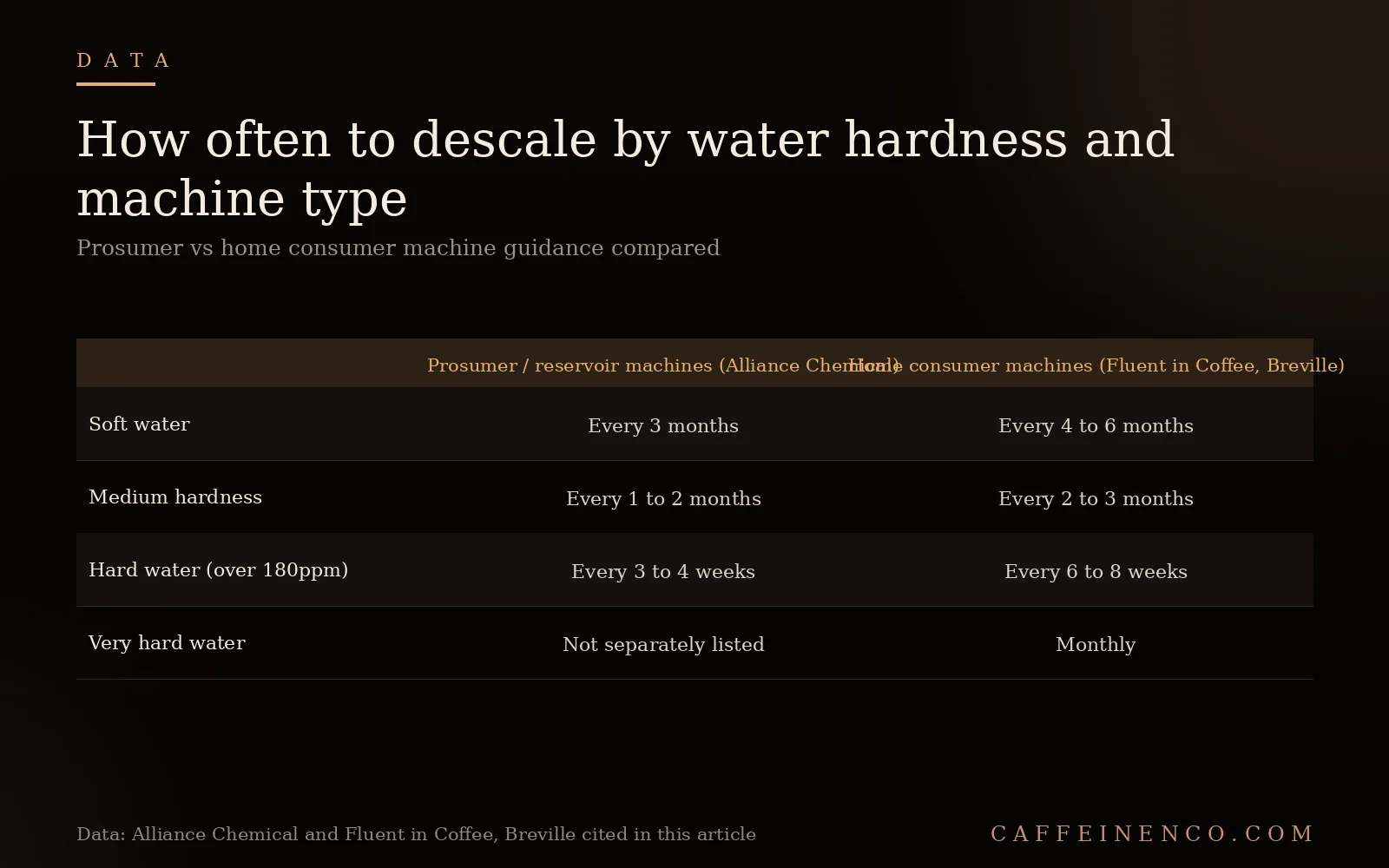
| Water hardness | Prosumer / reservoir machines (Alliance Chemical) | Home consumer machines (Fluent in Coffee, Breville) |
|---|---|---|
| Soft water | Every 3 months | Every 4 to 6 months |
| Medium hardness | Every 1 to 2 months | Every 2 to 3 months |
| Hard water (over 180ppm) | Every 3 to 4 weeks | Every 6 to 8 weeks |
| Very hard water | Not separately listed | Monthly |
Both sources agree on the underlying logic even where the exact windows differ by machine type: harder water deposits scale faster, and a machine run hard on hard water needs descaling closer to monthly than quarterly. Alliance Chemical also gives a useful trigger that works regardless of which schedule you follow: descale “every time the machine starts pulling slower than usual,” since a slowing shot is often the first symptom of scale building up inside the boiler and pump before you would otherwise notice.
Citric acid vs vinegar: why the recommendation has shifted

Vinegar is the answer most people already know, and it does work, but every sourced guide here treats it as the option to move away from rather than the one to reach for first. Alliance Chemical is direct about the mechanism: “vinegar and high-concentration citric acid both pit aluminum permanently, damage is not covered by warranty,” specifically because acetic acid is more aggressive on aluminum boiler components than citric acid at a comparable strength. Fluent in Coffee’s reporting on Breville’s own guidance goes further, stating that “Breville explicitly warns against it in their manuals” and that using vinegar “can void your warranty,” on top of noting that acetic acid degrades internal rubber gaskets and O-rings with repeated use.
Citric acid is the sourced alternative every guide converges on, for two practical reasons beyond the aluminum question: any residual citric acid taste clears within 8 to 12 espresso pulls, per Alliance Chemical’s own figure, and, per that same source, it does not leave the lingering smell and taste vinegar is known for. Home Grounds gives a simple home ratio: one quart of water to two tablespoons of citric acid. Chris’ Coffee gives a similar figure for reservoir machines specifically, 1 to 2 ounces of citric acid per 64 ounces of water.
Alliance Chemical’s ratios are more specific still, and they matter because a mix that is too strong is not just wasted citric acid, it is a real risk to the machine:
| Boiler / water type | Citric acid concentration |
|---|---|
| Stainless steel boiler (baseline) | About 20 grams per liter |
| Aluminum boiler | Capped at 15 grams per liter, to avoid pitting |
| Hard water (over 180ppm) | Around 25 grams per liter |
| Soft water | Lower end of the range |
Fluent in Coffee’s own conversion for Breville’s consumer machines, roughly 2 tablespoons (about 30 grams) of food-grade citric acid per liter of water, sits a notch above even Alliance Chemical’s hard-water figure. Home Grounds’ quart-and-two-tablespoon home ratio works out to almost exactly the same concentration, since a quart is close to a liter. That is a real, if unintentional, convergence: two separate home-focused sources both land on a citric acid mix strong enough to count as a hard-water dose by Alliance Chemical’s own scale, regardless of how hard your actual water is. If you know your machine has an aluminum boiler, that is worth diluting down toward Alliance Chemical’s 15 gram per liter ceiling rather than following the stronger home recipes as written.
Alliance Chemical adds one more genuine safety note worth repeating exactly: “never pour an 80 degree Celsius or hotter solution into a room-temperature machine” if it has a ceramic boiler, since the thermal shock can crack it. Mix and use descaling solution at a moderate temperature, not straight off the boil.
What Breville and De’Longhi actually tell their own customers
If you own a Breville or De’Longhi machine, the manufacturer’s own guidance narrows the choice further, and it points the same direction as the independent sources above. De’Longhi’s own US support FAQ states plainly: “We recommend to use our De’Longhi descaling solution which is designed specifically for our machines,” and directs owners to model-specific video instructions rather than a universal recipe, since De’Longhi’s lineup spans pump machines, super-automatics, and manual models with different internal plumbing. Fluent in Coffee’s reporting on Breville’s official manuals describes the same brand-first posture: Breville’s own descaling powder comes in pre-measured packets specifically so owners are not left guessing at concentration, which is the same problem Alliance Chemical’s ratio table above is trying to solve for anyone using loose citric acid instead.
None of this means citric acid is unsafe in a Breville or De’Longhi machine specifically. It means the manufacturer’s own packaged product removes the concentration guesswork entirely, at the cost of paying more per descale than a bag of food-grade citric acid. If cost matters more than convenience, a citric acid based descaling solution from 1st in Coffee’s barista tools range or on Amazon both work from the same ratios covered above; a manufacturer’s own packaged sachets simply take the measuring step out of your hands.
Worked example: descaling a reservoir espresso machine
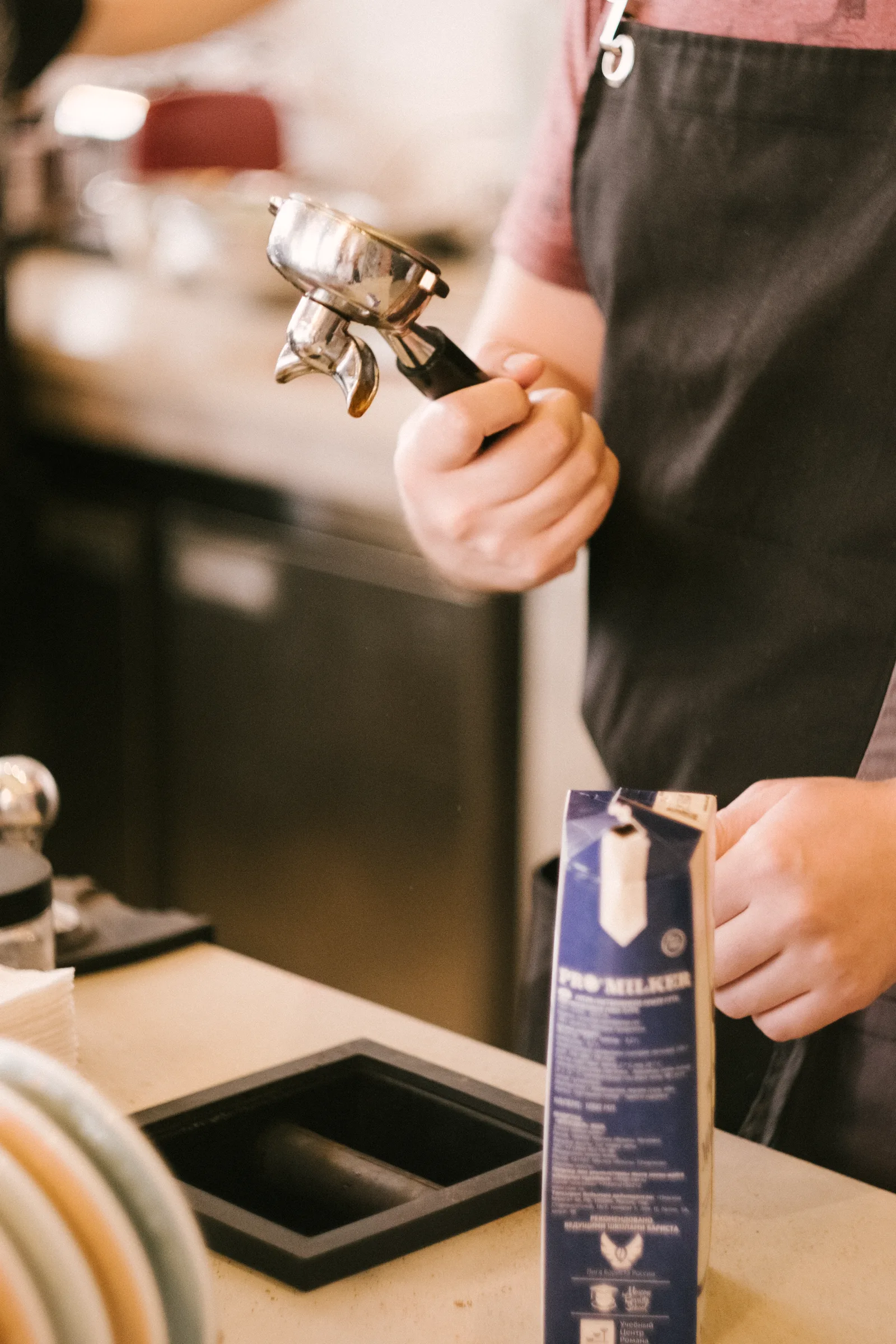
Chris’ Coffee’s own process, written specifically for reservoir-style home and prosumer machines rather than plumbed-in commercial units, is the most detailed step-by-step sequence among the sourced guides, and it applies to most home espresso machines with a removable water tank:
- Choose your solution. Straight white vinegar, or a citric acid mix at 1 to 2 ounces per 64 ounces of water, per Chris’ Coffee. Use a citric acid mix instead if your machine has an aluminum boiler or the manufacturer’s manual warns against vinegar, per the section above.
- Fill the reservoir with your chosen solution instead of plain water.
- Pull about 8 ounces through the group head, then about 8 ounces from the hot water wand if your machine has one. Chris’ Coffee is specific about a safety limit here: “it is important not to drain more than 8oz from the hot water tap at a time so as to avoid damaging the element.”
- Wait about an hour, then repeat the same 8-ounce pulls from both outlets. Continue this hourly cycle until the reservoir is empty.
- If your machine has drain ports on its boilers, let it cool fully first, then drain them before moving to the rinse phase.
- Refill the reservoir with plain water and begin the flush: pull about 8 ounces through the group head, then 6 to 8 ounces from the hot water wand, letting the machine reheat between cycles.
- Repeat the flush cycle until the water runs clear and tastes clean. Alliance Chemical’s own test is the most concrete way to check this: pull a single espresso and discard it; if it tastes acidic or sour, run one more full rinse cycle before trusting the machine with a cup you intend to drink.
- Resume normal use. The full cycle takes longer than a quick rinse, closer to a few hours including the wait periods, which is exactly why most of the sourced guidance above recommends stretching the interval between descales rather than treating this as a five-minute weekly chore.
Common mistakes
Using straight vinegar in a machine with an aluminum boiler is the most consequential mistake on this list, since per Alliance Chemical the pitting it causes is permanent and explicitly not covered under warranty. Mixing citric acid stronger than your boiler material calls for is a close second; both of the simple home ratios given by Home Grounds and Fluent in Coffee land at or above Alliance Chemical’s own hard-water concentration, which is more than an aluminum boiler should see regardless of how hard your water actually is. Skipping the rinse test is the third mistake; a machine that still tastes faintly acidic after the standard rinse cycles needs one more pass, not a shrug, since residual citric acid takes 8 to 12 pulls to fully clear per Alliance Chemical. Draining more than 8 ounces from a hot water wand in a single pull is the fourth mistake, specific to reservoir machines, since Chris’ Coffee’s own guidance warns this can damage the heating element regardless of which descaling solution is in the tank. Treating descaling frequency as fixed rather than tied to your actual water hardness is the fifth; a soft-water household following a hard-water schedule is wasting descaling solution and machine wear for no real benefit, and the reverse mistake, a hard-water household waiting three months because a general guide said so, is how machines end up needing this guide in the first place.
Common questions
How often should I descale my espresso machine? It depends on water hardness rather than a fixed number. Alliance Chemical’s ranges run from every 3 months for soft water down to every 3 to 4 weeks for water over 180ppm hardness; Fluent in Coffee’s figures for Breville’s consumer machines run a bit longer at every stage, from 4 to 6 months for soft water down to monthly for very hard water. A slowing shot is a reliable trigger regardless of schedule.
Should I use vinegar or citric acid to descale? Citric acid, per every sourced guide here. Vinegar works, but Alliance Chemical states that vinegar and high-concentration citric acid both pit aluminum boiler components permanently, and Fluent in Coffee’s reporting on Breville’s own manuals says the brand explicitly warns against vinegar and can treat resulting damage as a warranty issue.
What is the right citric acid ratio for descaling? Roughly 15 to 25 grams per liter depending on your boiler material and water hardness, per Alliance Chemical: about 20 grams per liter for a stainless boiler, capped at 15 grams per liter for an aluminum boiler, and up to 25 grams per liter for genuinely hard water. Home Grounds’ simple home ratio, one quart of water to two tablespoons of citric acid, and Fluent in Coffee’s roughly 30-gram-per-liter Breville conversion both land at or above that hard-water figure, so dilute them down if you know your machine has an aluminum boiler.
Can I use my machine’s manufacturer descaling solution instead of citric acid? Yes, and for Breville and De’Longhi machines specifically, that is what both brands actually recommend. De’Longhi’s own US support page states it recommends “our De’Longhi descaling solution which is designed specifically for our machines.” The tradeoff is cost, not safety: a packaged sachet removes the concentration guesswork the ratio table above exists to solve.
How do I know a descale actually worked? Per Alliance Chemical’s own test, pull a single espresso after your final rinse cycle and discard it. If it tastes acidic, metallic, or sour, run one more full rinse cycle before drinking anything the machine produces. Residual citric acid typically takes 8 to 12 pulls to fully clear on its own if you skip this check.
Is a slow espresso shot always a sign I need to descale? Not always, but it is one of the most common early symptoms. Alliance Chemical lists a slowing shot as a practical trigger for descaling regardless of your regular schedule. If a descale does not resolve a slow shot, this site’s own guide to espresso extraction speed covers the grind and dose causes that are the next most likely culprits.
For more sourced brewing fixes like this one, delivered weekly, subscribe to The Sunday Pour.
Sources & data
- Alliance Chemical: How to Descale an Espresso Machine with Food-Grade Citric Acid, Exact Ratios and Safety Tips
- Chris' Coffee: Descaling Your Reservoir Espresso Machine
- Home Grounds: How to Descale an Espresso Machine, Decalcifying Tips
- De'Longhi US: How Do I Descale My Pump Espresso Machine?
- Fluent in Coffee: How to Descale a Breville Espresso Machine, All Models