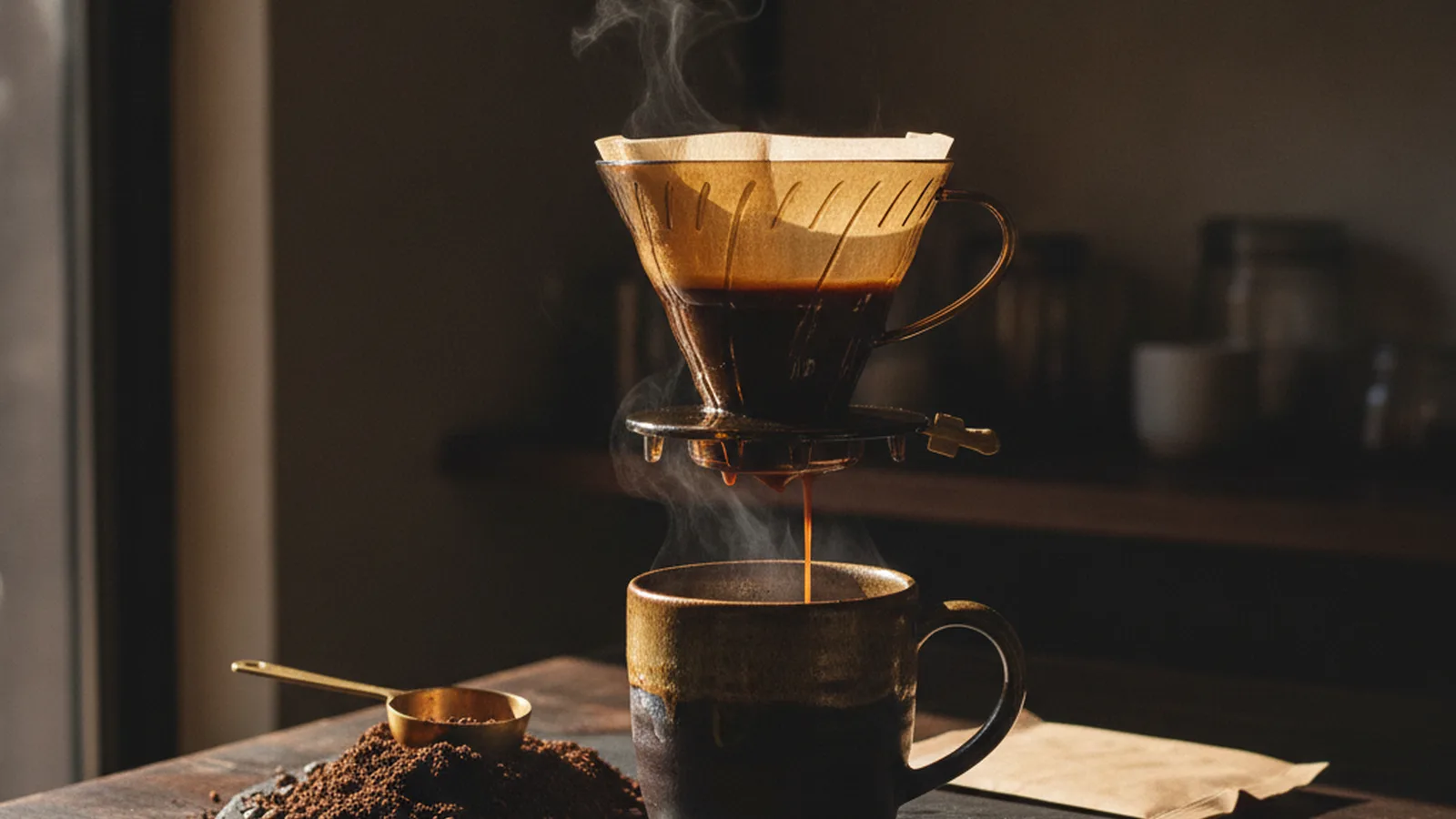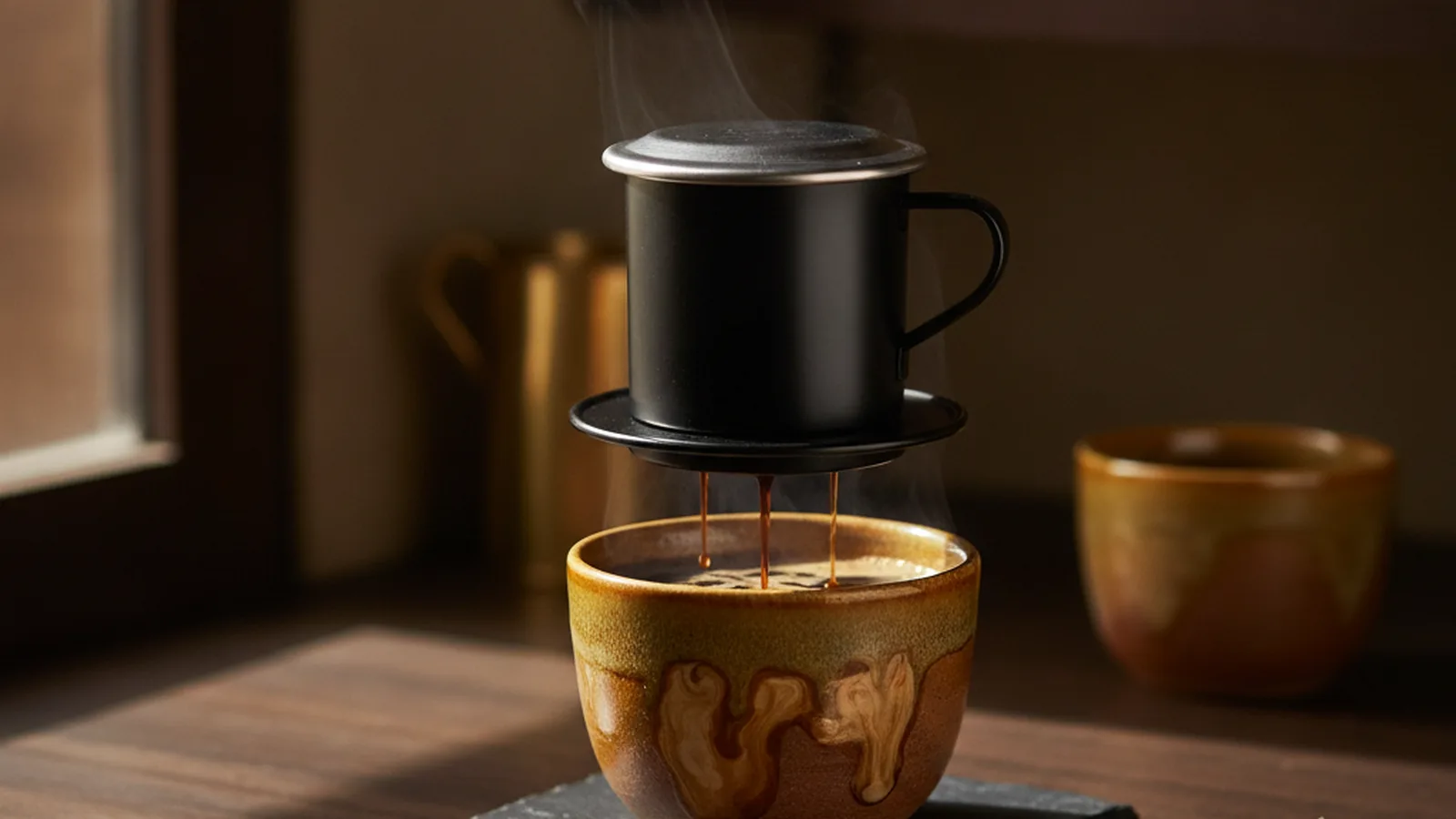
Every other brewing method this site has walked through, AeroPress, Chemex, Kalita Wave, moka pot, percolator, Turkish coffee, gets a dedicated ratio and grind size guide with a gram amount and a worked recipe. The phin, the small metal filter that sits on top of a cup and drips Vietnamese coffee straight through, has not, despite being one of the most distinctive brewing methods in daily use anywhere in the world. That gap is worth closing carefully rather than quickly, because search for a phin ratio and the numbers genuinely do not agree: one sourced guide lands near 1:2, another near 1:4, a third closer to 1:6, and a fourth closer to 1:8. That is not four guides being sloppy. It reflects a real structural difference between phin and almost every other method on this site: the cup that comes out of a phin is often the finished drink itself, poured over ice or stirred into condensed milk rather than diluted the way a drip concentrate would be, so how strong a given guide brews its coffee depends heavily on what that guide assumes happens to the cup next.
The ratio: why four sourced guides land in four different places

Four independently published guides give four different ratios, and laying them side by side actually explains the spread rather than deepening it:
| Source | Coffee | Water | Ratio |
|---|---|---|---|
| Cafely | Stated directly | Stated directly | 1:2 to 1:4 |
| Mr. Phin | 22g | 88ml | 1:4 |
| Coava Coffee Roasters | 16g | 100g | About 1:6.25 |
| Copper Cow Coffee | 14g (2 tbsp) | 4 fl oz (about 118g) | About 1:8.4 |
Cafely’s own ratio range calls for a genuinely concentrated pour, in keeping with the traditional Vietnamese style: a small, strong shot of coffee meant to be stirred into sweetened condensed milk or poured over ice, not sipped black at drip-coffee strength. Mr. Phin’s 1:4 sits in the same tradition, one step lighter. Coava’s 16g-to-100g recipe comes from a specialty coffee roaster’s gravity-press method that explicitly finishes with the brewed coffee combined “with water, milk, or your mixer of choice” after the phin itself is done working, meaning Coava’s own 1:6.25 is already a step toward a drink meant to be extended rather than drunk as a small shot. Copper Cow’s 1:8.4 is the lightest of the four, closer to how a phin performs when treated as a black-coffee brewer rather than a concentrate-and-dilute method.
The honest read is that there is no single “correct” phin ratio the way there is a converged range for, say, percolator coffee. Instead there are two real traditions living under the same name: a strong 1:2 to 1:4 concentrate meant for condensed milk or ice, and a lighter 1:6 to 1:8 pour meant to be drunk closer to as-is. Start at 1:4, the point where Mr. Phin’s own number and Cafely’s own range overlap, and adjust from there once you know which style you actually want.
| If you want… | Start here |
|---|---|
| A traditional cà phê sữa đá (iced coffee with condensed milk) | 1:2 to 1:4, closer to Cafely’s concentrate |
| A phin brew you drink closer to black, drip-style | 1:6 to 1:8, closer to Coava or Copper Cow |
| A first attempt with no strong preference yet | 1:4, per Mr. Phin, the point where the two traditions overlap |
The grind: not one word, but every source agrees on the ballpark
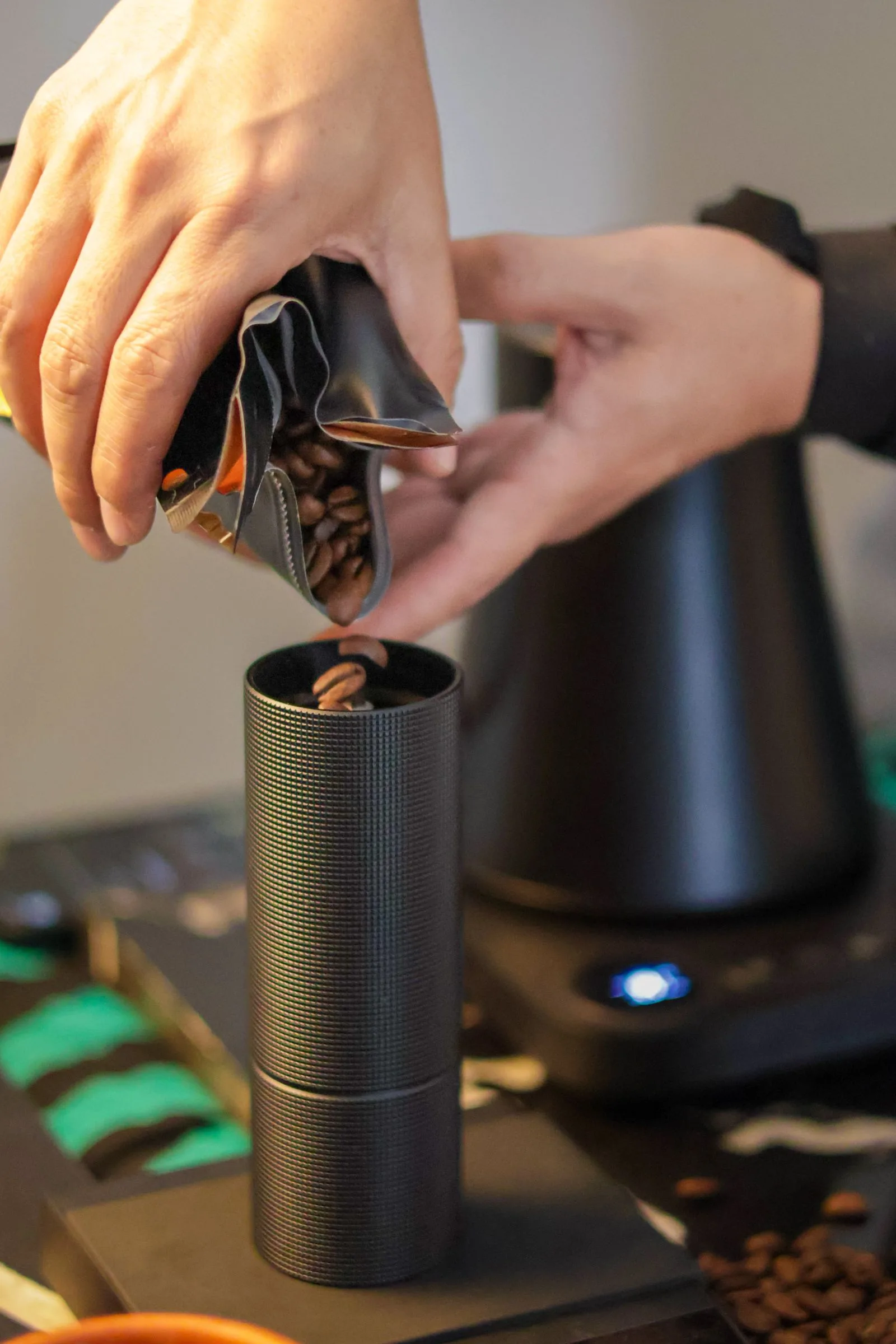
The words each guide reaches for are different, but the target they describe is close enough to count as agreement. Coava calls for a “medium” setting. Copper Cow calls for “medium-fine,” specifying it is “not as fine as espresso, but a little finer than a pour-over.” Mr. Phin also calls for “medium-fine,” comparing the texture to “table salt.” Cafely’s main brewing instructions call for a “fine grind (like sand),” while its own FAQ separately states that “a medium to medium-fine grind works best with a Phin filter,” which is the same territory the other three sources are pointing at, just split across two different parts of the same page.
Put plainly: aim for a grind finer than a pour-over or Chemex, coarser than espresso, and somewhere around table salt in texture. That single target holds across every source consulted for this guide, which is a tighter agreement than the ratio numbers managed. Grind too fine and the metal mesh grounds basket a phin uses in place of a paper filter clogs, stalling the drip or stopping it outright; grind too coarse and water rushes through too fast, producing a thin, under-extracted cup that defeats the entire point of a method built to brew something strong and concentrated. A burr grinder set to a medium-fine setting holds that target far more consistently than a blade grinder, which tends to produce an uneven mix of fine dust and coarse chunks in the same batch, or you can browse the same category on Amazon.
Water temperature and timing: the part every source actually agrees on
Where the ratio splits and the grind wording varies, water temperature converges tightly. Copper Cow calls for 190 to 205 degrees Fahrenheit, or “just below a boil.” Cafely calls for 200 degrees Fahrenheit within a 195 to 205 range. Mr. Phin calls for 92 to 96 degrees Celsius, which converts to roughly 197.6 to 204.8 degrees Fahrenheit. All three sit inside the same narrow band, just under boiling, and none of them call for water anywhere close to a full rolling boil.
Timing tells a similarly consistent story once the numbers are lined up:
| Source | Total brew time | First drip |
|---|---|---|
| Copper Cow Coffee | 3 to 5 minutes | Not specified |
| Coava Coffee Roasters | 5 to 6 minutes | Watch for it by 2:00 to 2:30 |
| Cafely | 5 to 8 minutes | Around 2 minutes |
| Mr. Phin | 4 to 5 minutes | Not specified |
Every source that gives a first-drip benchmark lands on roughly the two-minute mark, and total brew time across all four clusters between 3 and 8 minutes, with most guides converging closer to 4 to 6. That two-minute first-drip window is the single most useful troubleshooting number in this entire guide: if nothing has dripped by 2:30, per Coava’s own instruction, the grounds are packed too tightly or ground too fine, and the fix is to gently lift the press or filter disc with a spoon rather than waiting it out.
Worked example: brewing your first cup
- Heat water just under boiling. Target 195 to 205 degrees Fahrenheit (about 91 to 96 degrees Celsius), the band all three sourced guides that specify temperature agree on. A kettle just off the boil, left to sit 30 seconds, gets you into this range without a thermometer.
- Grind medium-fine. Aim for a texture close to table salt, finer than you would use for a pour-over, coarser than espresso, per the converged guidance from Coava, Copper Cow, and Mr. Phin.
- Dose your grounds. Start at 1:4 by weight, the overlap point between Mr. Phin’s stated ratio and Cafely’s stated range. For a standard single-serve phin, that is roughly 14 to 16 grams of coffee.
- Assemble the phin. Set the perforated filter plate on your cup, place the brewing chamber on top, add the grounds, and shake the chamber gently to level the bed before inserting the press or filter disc.
- Bloom first. Pour a small amount of hot water, just enough to saturate the grounds evenly, and let it sit for 45 to 60 seconds before adding the rest, per both Copper Cow’s and Coava’s brewing steps.
- Fill and wait. Add the remaining water, place the lid on loosely so it does not seal airtight and block the drip, and let the phin work. Expect the first drops within about 2 minutes.
- Give it the full window. Most cups finish in 4 to 6 minutes; if it is still dripping well past 8 minutes, the grind was likely too fine this time, and going one step coarser on the next attempt is the fix.
- Serve it your way. For a traditional cà phê sữa đá, stir the finished concentrate into 1 to 2 tablespoons of sweetened condensed milk and pour over ice. For a black cup closer to drip strength, drink it as-is or top up with a little extra hot water.
- If you are shopping for your first phin filter, 1st in Coffee’s coffee maker range and phin filters on Amazon both carry the traditional stainless steel design this guide walks through.
Filter sizes and how much coffee each one takes
Phin filters are not sold in one universal size, and the dose scales with the filter rather than with a fixed ratio alone. Per Cafely’s own sizing chart, built around how many servings a given filter is meant to produce:
| Filter size | Servings | Coffee amount |
|---|---|---|
| 4 oz (extra small) | 1 | 2 tablespoons (about 14g) |
| 6 oz (small) | 1 to 2 | 3 tablespoons (about 21g) |
| 8 oz (medium) | 2 to 3 | 4 tablespoons (about 28g) |
| 12 oz (large) | 3 to 4 | 6 tablespoons (about 42g) |
| 24 oz (extra large) | 4 to 6 | 12 tablespoons (about 84g) |
Notice the dose scales in a straight line with filter size, roughly 7 grams of coffee for every additional serving, which makes scaling up a group brew simple: multiply your usual single-serve dose by the number of cups you need rather than guessing at a bigger filter’s capacity.
Why the cup that comes out is often the finished drink, not a concentrate to dilute
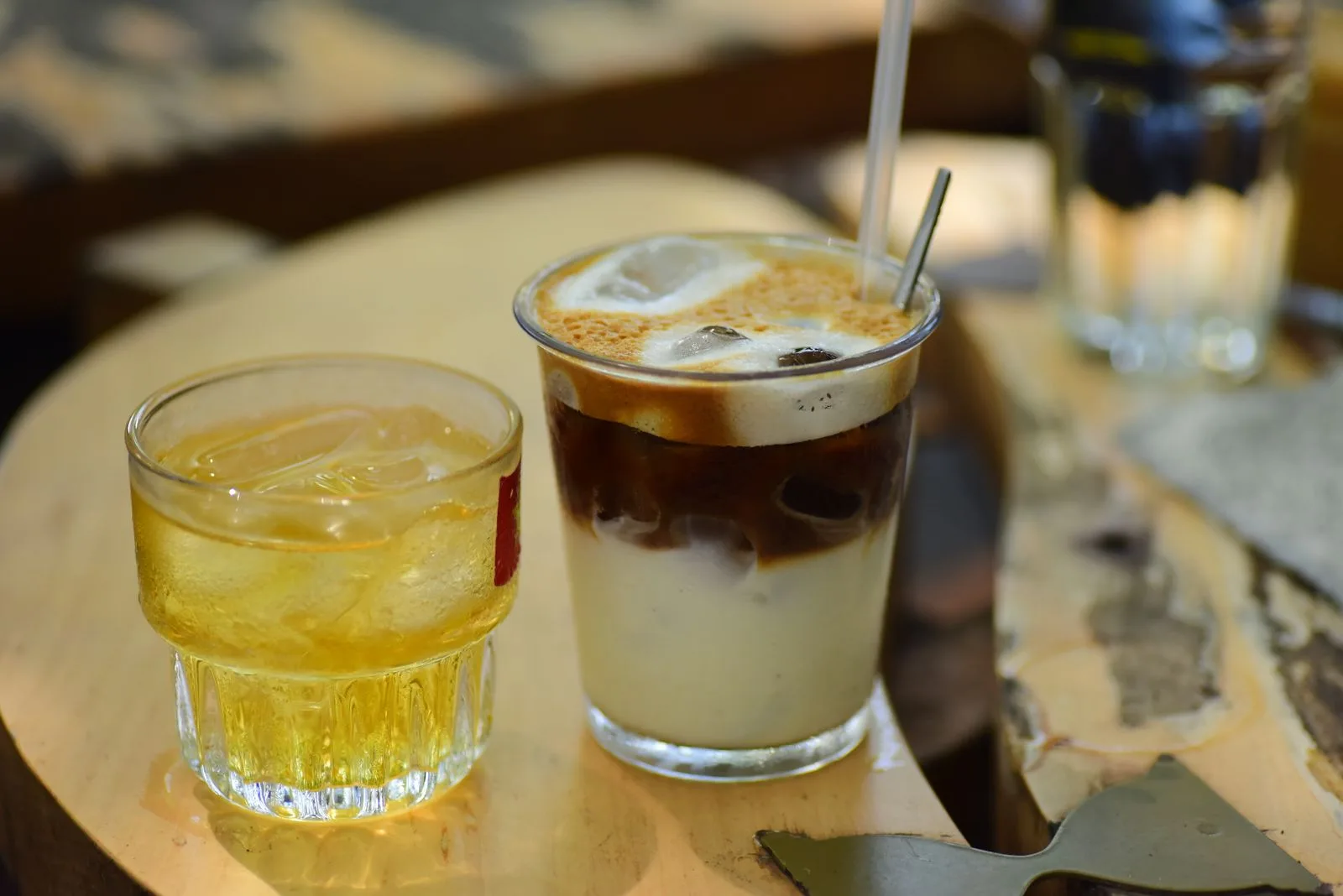
The pairing of coffee and sweetened condensed milk that defines cà phê sữa đá is not a modern invention. Per Sprudge’s own reporting on Vietnamese coffee history, the tradition “dates back to the 1850s, and the establishing of French colonial rule,” a period when fresh milk spoiled quickly in Vietnam’s tropical climate while condensed milk, which “lasted longer in the tropical climate and didn’t need to be refrigerated,” became the practical substitute. That single logistical fact from a century and a half ago still shapes how most phin guides frame their ratio today: a strong, concentrated pour built to be balanced by sweetness and dilution rather than drunk black at drip strength, which is exactly the pattern behind Cafely’s 1:2 to 1:4 figures and Mr. Phin’s 1:4.
Sprudge also frames the phin itself as a deliberately slow method, describing the process as producing “a nicely concentrated coffee” through unhurried dripping, comparable in spirit to a V60 or AeroPress even though the mechanics differ. That slowness is not incidental. This site’s own drip coffee ratio guide documents a 1:15 to 1:18 range for standard drip brewing, meant to be drunk as-is straight from the pot. A phin brewed at even the lightest sourced ratio here, Copper Cow’s roughly 1:8.4, is still close to twice as concentrated as standard drip, and at the strong end, Cafely’s 1:2, it is closer to seven or eight times as concentrated. That is by design: the phin was never meant to compete with drip coffee on the same terms, it was built to produce a small, intense pour that condensed milk and ice were always going to finish.
How phin compares to other concentrated methods on this site
Phin is not the only method on this site that brews well outside drip’s 1:15 to 1:18 range. Turkish coffee runs 1:8 to 1:12, and moka pot runs 1:7 to 1:8, both concentrated by design but neither reaching phin’s strong end. At Cafely’s stated 1:2 to 1:4, phin’s most traditional preparation is meaningfully more concentrated than either of those methods, which tracks with how each drink is actually served: Turkish coffee is sipped slowly from a small cup with the grounds left in, moka pot coffee is often stretched with hot water into an Americano-style cup, and traditional phin coffee is built from the outset to be cut with condensed milk or poured over a full glass of ice.
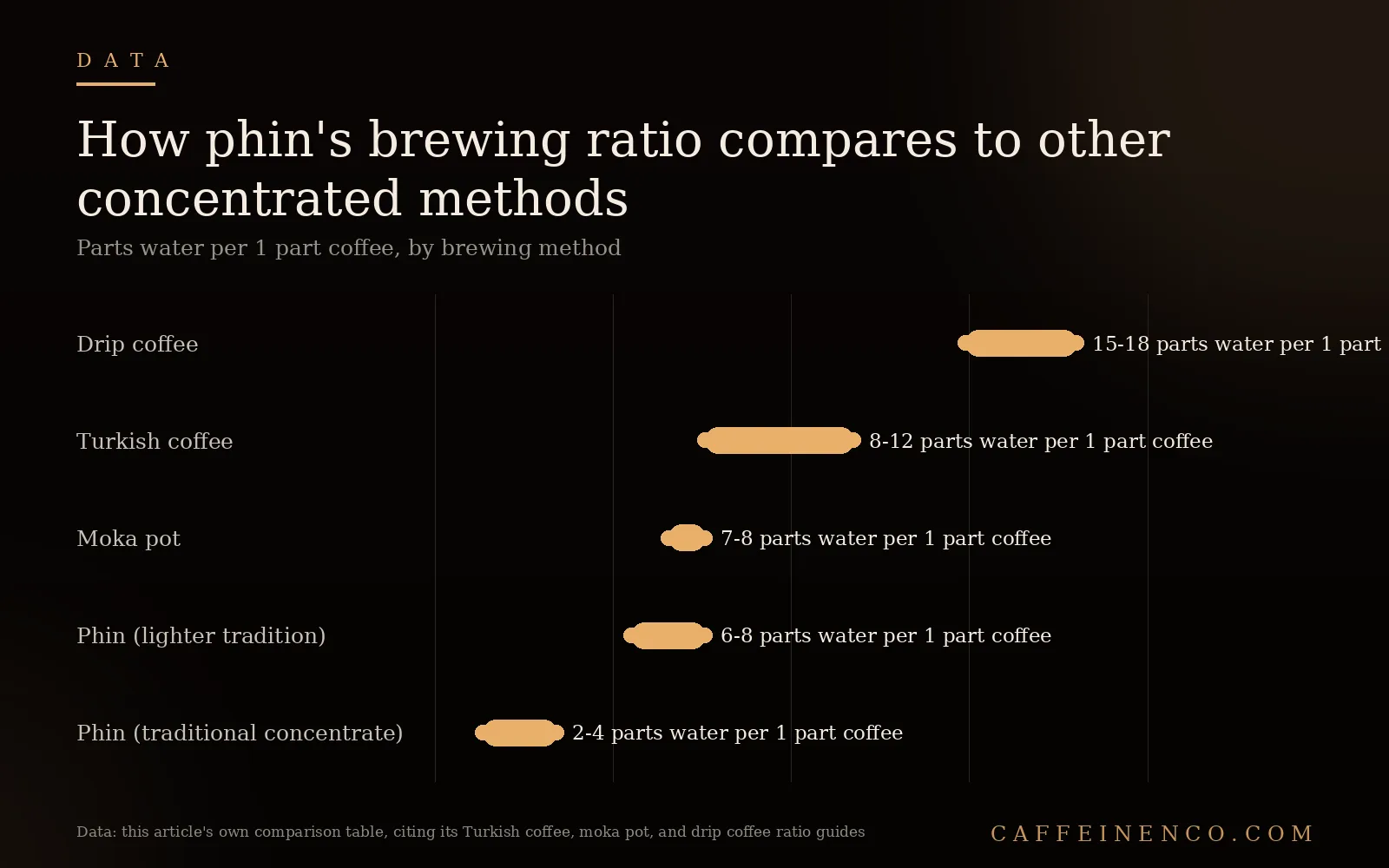
| Method | Typical ratio | How it is usually served |
|---|---|---|
| Drip coffee | 1:15 to 1:18 | As-is |
| Turkish coffee | 1:8 to 1:12 | As-is, grounds included, sipped slowly |
| Moka pot | 1:7 to 1:8 | As-is, or stretched with hot water |
| Phin (lighter tradition) | 1:6 to 1:8 | As-is or lightly extended |
| Phin (traditional concentrate) | 1:2 to 1:4 | Cut with condensed milk or poured over ice |
Common mistakes
Assuming there is one “correct” phin ratio and getting frustrated when different guides disagree is the most common mistake; the 1:2 to 1:8 spread reflects two genuinely different traditions, a condensed-milk concentrate and a lighter black-coffee style, not sloppy sourcing. Grinding too fine to try to slow the drip down further is the second mistake; per Coava’s own guidance, a stalled drip at 2:30 with no first drop means lifting the press, not tolerating a clogged, over-extracted brew. Treating the “cup size” printed on a filter as the literal water volume poured through the grounds is the third mistake; Cafely’s own sizing table scales coffee dose by serving count, and the finished drink often includes ice or condensed milk added after the phin itself has stopped dripping, not just water measured before brewing. Using a rolling boil instead of water just under boiling is the fourth mistake; every sourced guide here that specifies temperature stays in the 195 to 205 degree Fahrenheit band, not a full boil.
Common questions
What is the correct coffee-to-water ratio for a phin filter? There is a real range rather than one number: roughly 1:2 to 1:4 for the traditional concentrate style meant for condensed milk, per Cafely and Mr. Phin, or 1:6 to 1:8 for a lighter pour meant to be drunk closer to black, per Coava Coffee Roasters and Copper Cow Coffee. Start at 1:4 and adjust from there.
What grind size should I use for Vietnamese phin coffee? Medium-fine, close to the texture of table salt, per Mr. Phin’s own description. That sits finer than a pour-over grind and coarser than espresso, a target every sourced guide in this article agrees on even when the exact wording differs.
Why is my phin coffee dripping too slowly or not at all? The grind is almost always too fine, or the grounds are packed too tightly under the press. Per Coava’s own instruction, if no drip has appeared by 2:30, gently lift the press or filter disc with a spoon to loosen the bed rather than waiting it out.
How long should a phin take to brew? Most sourced guides land between 4 and 6 minutes total, with the first drip appearing around the 2-minute mark. Cafely’s slightly wider 5 to 8 minute window and Copper Cow’s 3 to 5 minute window both sit close to that same center.
Is Vietnamese phin coffee stronger than regular drip coffee? Yes, at every sourced ratio in this guide. Even the lightest figure here, Copper Cow’s roughly 1:8.4, is close to twice as concentrated as standard drip’s 1:15 to 1:18 range documented in this site’s own drip coffee ratio guide, and the traditional 1:2 to 1:4 concentrate style is several times stronger still.
What water temperature should I use for a phin? 195 to 205 degrees Fahrenheit, or roughly 91 to 96 degrees Celsius, per Copper Cow Coffee, Cafely, and Mr. Phin, all of which converge on the same just-under-boiling range.
For more sourced brewing breakdowns like this one, delivered weekly, subscribe to The Sunday Pour.