This site’s Dunkin’, McDonald’s, Starbucks, Tim Hortons, and Panera breakdowns cover five of the biggest coffee counters in the US, but Peet’s Coffee has been missing, despite being the chain with arguably the strongest claim to actually shaping how the other five roast their beans. Peet’s own timeline page states that when “three young entrepreneurs approach Mr. Peet to learn the critical roasting and blending aspects of the coffee business,” in 1971, “he provides them with training as well as the roasted coffee beans for their new venture, Starbucks.” Alfred Peet opened his first store in Berkeley in 1966, and the company he built now publishes its own caffeine figures for brewed coffee, espresso, lattes, decaf, and iced coffee, plus a rare piece of company content that breaks caffeine down by roast level in actual percentages rather than a vague “about the same.” Two independent measurements from Caffeine Informer, cross-checked against Peet’s own published figures, give this page enough to build the same depth of breakdown the other five chains already have.
The official numbers: brewed coffee, and the roast that trained Starbucks
Peet’s brewed coffee runs 267mg of caffeine in a 16 fl oz cup, per Caffeine Informer’s figures sourced from Peet’s customer service and peets.com. That works out to about 16.7mg per fluid ounce, a genuinely strong pour compared with the other chains this site has measured, a fact the comparison table further down makes concrete.
| Size | Caffeine | Per fl oz |
|---|---|---|
| 16 fl oz (medium) | 267mg | About 16.7mg |
Caffeine Informer’s own note on this figure is worth repeating rather than smoothing over: “lighter roasts will yield slightly higher caffeine amounts and the number above reflects the average amount of caffeine you would expect in their medium sized brewed coffee.” That single sentence previews the next section almost exactly, roast level genuinely does move the number at Peet’s, just not by much, and Peet’s is unusually transparent about exactly how much.
Does roast level actually change the caffeine? Peet’s own blog gives an exact answer
Most chains either dodge this question or answer it in vague terms. Peet’s answered it in percentages. The company’s own blog post on the subject states plainly that “there’s virtually no difference in caffeine content between specific roasts,” then backs that claim with real numbers: light roast runs “approximately 1.13% caffeine,” medium roast runs “slightly higher caffeine content (1.17%),” and dark roast runs “1.08% caffeine.” That puts light and dark only 0.05 percentage points apart; the widest gap in the set is actually medium to dark, 0.09 percentage points, since medium tests as the highest of the three rather than falling neatly in the middle. Either way, it is about as close to “no difference” as a real measurement is likely to get.
| Roast | Caffeine by weight |
|---|---|
| Light | 1.13% |
| Medium | 1.17% (highest of the three) |
| Dark | 1.08% (lowest of the three) |
This site’s own roast level guide explains the mechanism behind why darker roasts are not automatically weaker: roasting drives off moisture and mass, which changes bean density more than it changes the caffeine molecule itself. Peet’s blog makes that same point from the practical side rather than the chemistry side: because roasted beans lose density as roasting time increases, “a scoop of light roast beans has more actual coffee beans than a scoop of dark roast,” so a volume-based scoop of light roast can end up carrying slightly more caffeine into the pot than the same scoop of dark roast, even though dark roast beans are not lower in caffeine gram for gram in any meaningful way. Peet’s own recommendation follows from that directly: measure coffee by weight, not by scoop, to keep caffeine intake consistent across roasts. Medium roast edging out both light and dark, rather than sitting neatly in between, is a small enough gap to be within normal batch-to-batch variation, but it is a real reported number, not a smoothed-over average, and that specificity is genuinely rare among the caffeine claims chains publish.
Espresso, lattes, and a shot-count pattern this site has not seen elsewhere
Peet’s espresso figures, per Caffeine Informer’s citation of peets.com, scale in a straight line with shot count: a single shot runs 70mg, a double runs 140mg, and a triple runs 210mg, each shot referenced against a 1.5 fl oz pour. That part is unremarkable on its own, doubling and tripling a fixed per-shot dose is exactly what you would expect.
What is worth flagging is what happens once espresso becomes a latte. Caffeine Informer’s separate page for Peet’s Caffe Latte lists 70mg at 12 fl oz, 140mg at 16 fl oz, and 210mg at 20 fl oz, the same three figures as the standalone single, double, and triple espresso numbers, lined up exactly with cup size.
| Size | Latte caffeine | Matching espresso shot |
|---|---|---|
| 12 fl oz (small) | 70mg | Single shot |
| 16 fl oz (medium) | 140mg | Double shot |
| 20 fl oz (large) | 210mg | Triple shot |
That is a genuinely different pattern from the one this site’s own Panera breakdown documented at a fast-casual competitor: every latte on Panera’s menu carries the identical 126mg regardless of whether it is a 16oz or a 20oz cup, because Panera fixes the shot count at a double no matter the size and only adds more milk as the cup grows. Peet’s appears to do the opposite, adding a full extra shot at each size step up, so ordering a large latte at Peet’s genuinely means ordering more caffeine, not just more milk. Caffeine Informer’s own note on the latte page backs the pattern: “all flavored latte’s at Peet’s would have the same number of espresso shots per size,” meaning a caramel or vanilla latte should track the same 70/140/210mg progression as a plain one. Peet’s espresso page separately states that “Peet’s Iced Espresso has the same amount of caffeine” as the hot version, so ordering espresso over ice does not change the dose.
Decaf: what actually remains in the cup
Peet’s decaf espresso carries 10mg of caffeine per 1.5 fl oz shot, per Caffeine Informer, seven times less than a standard shot’s 70mg but not literally zero. Decaf brewed coffee runs a wider 6 to 15mg range depending on the specific decaf blend and how it is brewed. Both figures sit inside the pattern this site’s own decaf coffee breakdown documents across other chains, typically 2 to 15mg per cup rather than a true zero, since no commercial decaffeination process removes caffeine completely.
Iced coffee and cold brew: two different drinks with two different strengths
Peet’s iced coffee, per Caffeine Informer, runs 113mg at 12 fl oz, 150mg at 16 fl oz, and 187mg at 20 fl oz, sourced from Peet’s customer service as “an estimate based on the amount of brewed coffee poured over 3/4 cup of ice,” with the explicit caveat that the real number “can vary due to a number of factors.” Working those figures out per fluid ounce lands them all close to 9.4mg, noticeably below hot brewed coffee’s 16.7mg per ounce, which tracks with how the drink is made: pouring hot-brewed coffee over a cup already partly filled with ice dilutes the final total even before any of the ice melts.
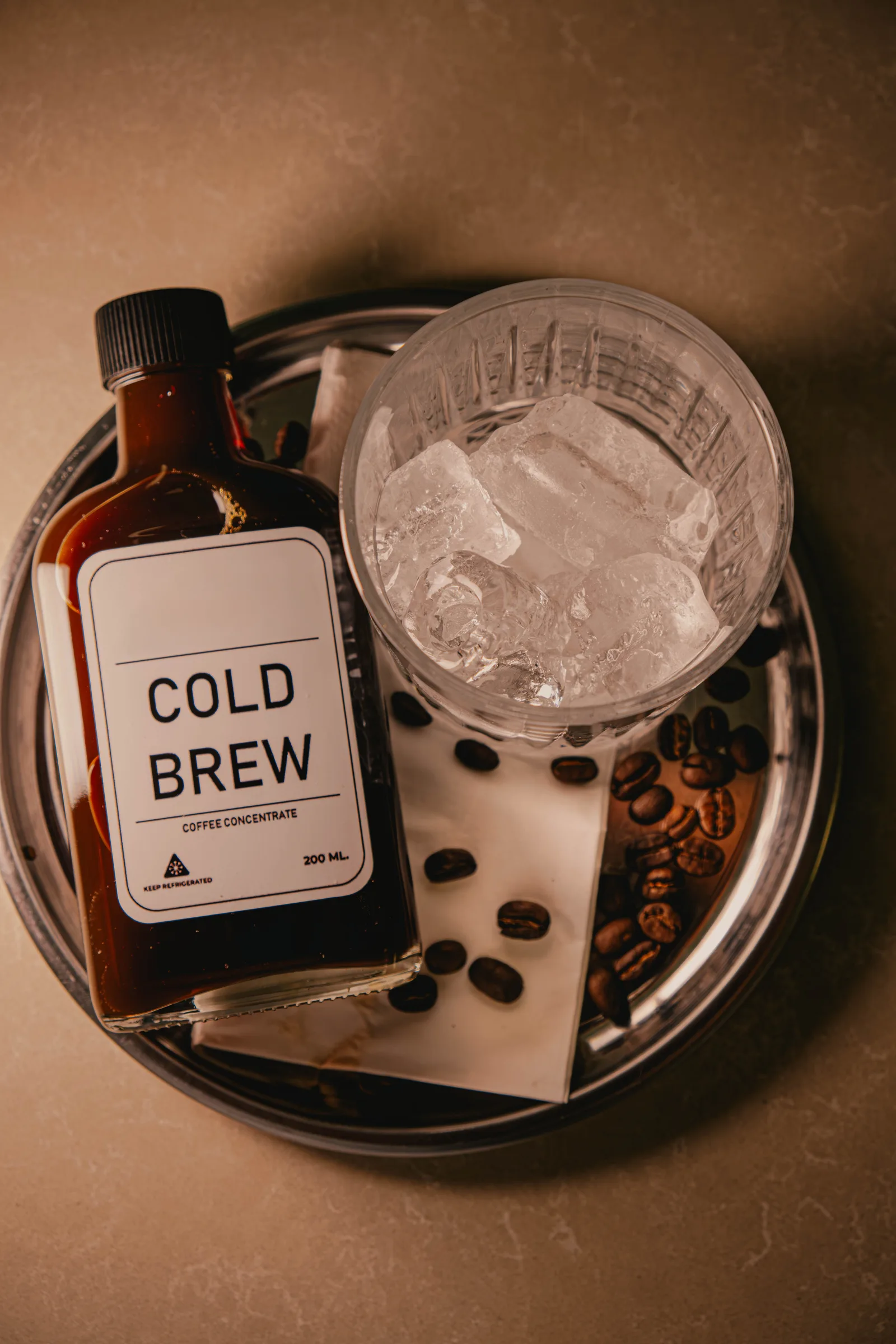
Cold brew is a different product entirely and a stronger one. Peet’s cold brew bottles carry 250mg of caffeine per 10.5 fl oz bottle, per Caffeine Informer’s figures sourced from Peet’s customer service and peets.com, which works out to roughly 23.8mg per fluid ounce, comfortably the strongest number anywhere on this page. Iced coffee is hot-brewed coffee diluted by ice; cold brew is steeped at a concentrated ratio and served closer to full strength, and the gap between 9.4mg and 23.8mg per ounce is the clearest illustration on this page of why “iced coffee” and “cold brew” are not interchangeable terms even when a menu board uses them loosely.
Worked example: hitting a specific caffeine target at Peet’s
- Start from the brewed coffee baseline. A 16 fl oz cup runs 267mg, per Peet’s own figures, already more than half the FDA’s general 400mg daily guidance, cited by MD Anderson Cancer Center, in a single cup.
- Pick a roast for flavor, not caffeine. Light, medium, and dark roast caffeine content sits within 0.09 percentage points of each other, per Peet’s own blog, so roast choice will not meaningfully change your dose.
- Count shots, not cup size, for espresso drinks. A single shot is 70mg, a double is 140mg, a triple is 210mg, and per Caffeine Informer’s figures, lattes appear to add a full shot at each size step, so a large latte is a genuinely bigger dose than a small one, not just a milkier one.
- Choose iced coffee over cold brew for a lighter dose in a cold drink. Iced coffee runs about 9.4mg per fluid ounce against cold brew’s roughly 23.8mg per fluid ounce, so swapping one for the other at the same cup size roughly halves or doubles the caffeine, depending on which direction you go.
- Drop to decaf espresso, not decaf brewed, for the lowest realistic dose. At 10mg per shot, decaf espresso is the single lowest number Peet’s publishes for anything resembling a coffee drink, lower than the 6 to 15mg range for decaf brewed coffee.
- If you are building a home setup to match Peet’s stronger pour, a burr grinder that holds a consistent, repeatable grind setting matters more for hitting a target strength than any specific bean, whether from 1st in Coffee’s grinder range or on Amazon.
How Peet’s stacks up against Starbucks, Dunkin’, Tim Hortons, Panera, and McDonald’s
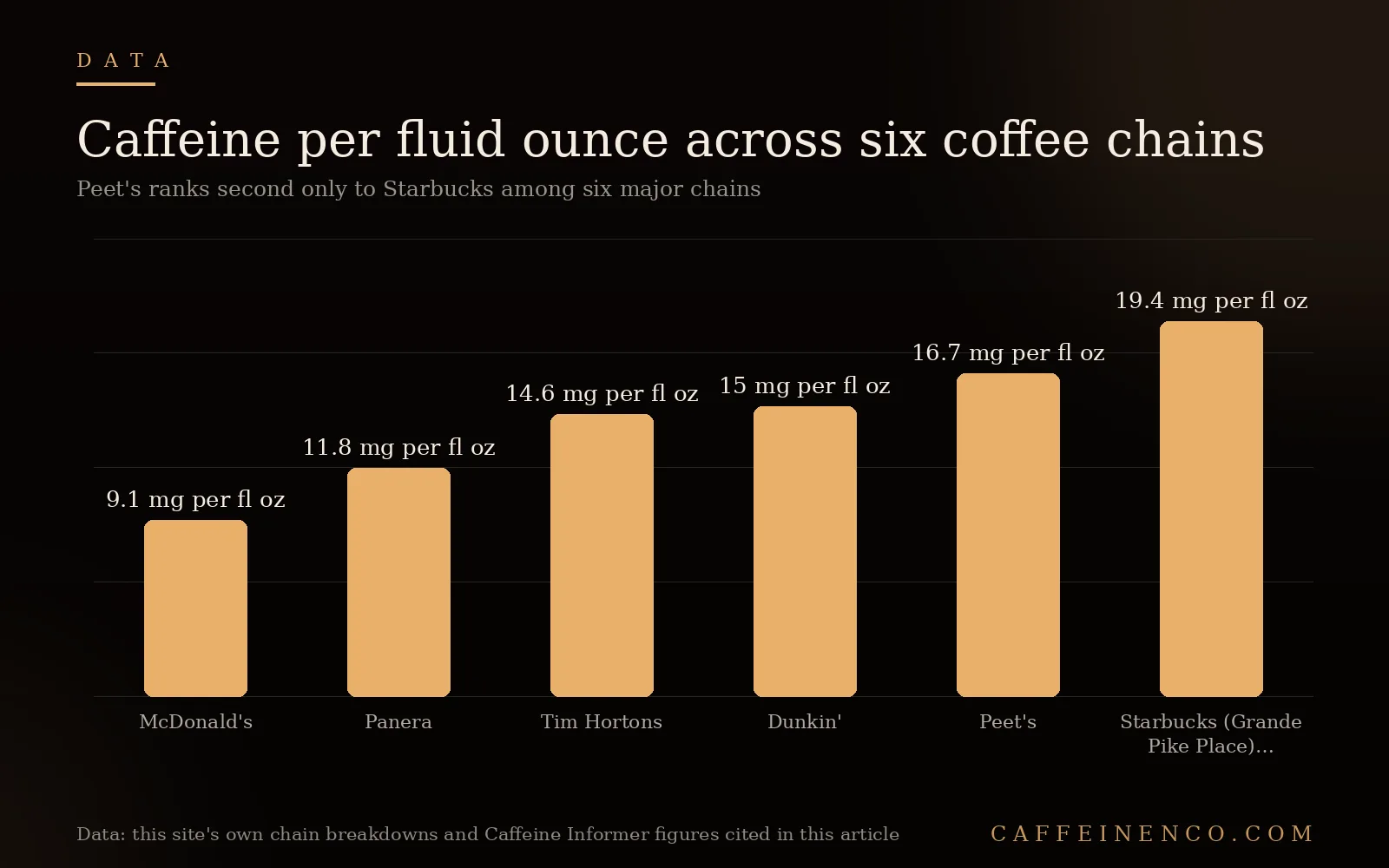
Comparing chains fairly means comparing caffeine per fluid ounce, since a “medium” is not the same pour everywhere. Peet’s 267mg in a 16oz cup works out to about 16.7mg per fl oz, which this site can now line up against the five chains already covered.
| Chain | Size | Caffeine | Per fl oz |
|---|---|---|---|
| McDonald’s | 16 fl oz | 145mg | About 9.1mg |
| Panera | 16 fl oz | 189mg | About 11.8mg |
| Tim Hortons | 14 fl oz | 205mg | About 14.6mg |
| Dunkin’ | 14 fl oz | 210mg | 15.0mg |
| Peet’s | 16 fl oz | 267mg | About 16.7mg |
| Starbucks (Grande Pike Place) | 16 fl oz | 310mg | About 19.4mg |
Peet’s lands second only to Starbucks per ounce, ahead of Dunkin’, Tim Hortons, Panera, and McDonald’s, a notable result for the chain whose founder personally trained Starbucks’ three co-founders in 1971 and sent them back to Seattle with his own roasted beans. Six decades later, the student’s flagship blend still edges out the teacher’s, but not by the margin the training-day origin story might suggest.
Common mistakes
Assuming a darker roast means a bigger jolt is the most common mistake on this page; Peet’s own blog reports the opposite ranking, medium roast highest at 1.17%, light next at 1.13%, dark lowest at 1.08%, a spread small enough to treat roast choice as a flavor decision rather than a caffeine decision. Assuming a bigger latte just means more milk is the second mistake; unlike this site’s Panera findings, Peet’s own published figures show latte caffeine climbing in step with cup size, 70mg, 140mg, then 210mg, tracking a single, double, then triple shot. Treating “iced coffee” and “cold brew” as the same drink is the third mistake; per Caffeine Informer’s figures, iced coffee runs about 9.4mg per fluid ounce against cold brew’s roughly 23.8mg, closer to a 2.5 times difference than a rounding error. Assuming decaf means zero caffeine is the fourth mistake; Peet’s own decaf espresso carries 10mg per shot, and decaf brewed coffee runs 6 to 15mg, both real, measurable amounts rather than none at all.
Common questions
How much caffeine is in Peet’s Coffee? 267mg in a 16 fl oz cup of brewed coffee, per Caffeine Informer’s figures sourced from Peet’s customer service and peets.com, about 16.7mg per fluid ounce.
Does roast level change how much caffeine is in Peet’s coffee? Barely. Peet’s own blog reports light roast at 1.13% caffeine by weight, medium at 1.17%, and dark at 1.08%, a spread of under 0.1 percentage points across the full roast range, so roast is better chosen for flavor than caffeine.
Does a bigger latte at Peet’s actually have more caffeine? Yes, unlike some competitor chains. Peet’s published figures show a 12oz latte at 70mg, a 16oz at 140mg, and a 20oz at 210mg, matching a single, double, and triple espresso shot respectively, so size genuinely changes the dose.
Is Peet’s coffee stronger than Starbucks? Close, but Starbucks edges it out. Peet’s 16oz brewed coffee runs about 16.7mg of caffeine per fluid ounce against Starbucks’ Grande Pike Place at about 19.4mg per fluid ounce, per this site’s own Starbucks breakdown, putting Peet’s second among the six chains this site has measured.
How much caffeine is in Peet’s decaf coffee? 6 to 15mg for decaf brewed coffee and 10mg for a decaf espresso shot, per Caffeine Informer’s figures, real but small amounts rather than a true zero, since no commercial decaffeination process removes caffeine entirely.
Is Peet’s cold brew stronger than its iced coffee? Substantially. Peet’s cold brew runs about 23.8mg of caffeine per fluid ounce in a 10.5oz bottle against iced coffee’s roughly 9.4mg per fluid ounce, since cold brew is steeped concentrated while iced coffee is hot-brewed coffee diluted over ice.
For more sourced caffeine breakdowns like this one, delivered weekly, subscribe to The Sunday Pour.
Sources & data
- Peet's Coffee: Timeline (Official History)
- Peet's Coffee: Light vs Medium vs Dark Roast, Which Has More Caffeine?
- Caffeine Informer: Caffeine in Peet's Brewed Coffee
- Caffeine Informer: Caffeine in Peet's Caffe Latte
- Caffeine Informer: Caffeine in Peet's Coffee Espresso
- Caffeine Informer: Caffeine in Peet's Iced Coffee
- Caffeine Informer: Caffeine in Peet's Decaf Espresso
- MD Anderson Cancer Center: How Much Caffeine Is Too Much?