“Cut out coffee” is near-universal advice for heartburn, repeated by doctors, diet sheets, and worried friends alike, but the actual mechanism behind it is more specific, and more negotiable, than a blanket ban suggests. GERD, gastroesophageal reflux disease, affects roughly 1 in 5 people in the United States, according to Cleveland Clinic, which makes “does coffee cause my reflux specifically” a genuinely different question from “does coffee cause reflux in general.” This site’s own coffee on an empty stomach breakdown already covers whether fasting-state timing changes nausea and ulcer risk, citing research that found no strong link there. This page covers a separate, better-established mechanism: what coffee actually does to the valve between your esophagus and your stomach, regardless of when you drink it, and which of the popular fixes, dark roast, cold brew, decaf, are backed by real measurements rather than cafe folklore.
What actually happens: the LES mechanism

Reflux itself is not caused by coffee directly, it is caused by a weak or overly relaxed lower esophageal sphincter (LES), the ring of muscle that normally keeps stomach contents from traveling back up into the esophagus. Cleveland Clinic is specific about coffee’s role in that mechanism: caffeine “can loosen up your lower esophageal sphincter (LES),” and coffee separately “can increase the production of gastric acid in your belly.” That is two distinct effects stacked on top of each other, a looser valve and more acid pressing against it, which is a more mechanically specific claim than “coffee is acidic so it causes heartburn.”
Cleveland Clinic’s coffee-and-reflux breakdown adds two variables that have nothing to do with acidity at all: volume and temperature. Drinking a large quantity in one sitting or drinking it very hot both amplify irritation on top of the LES and acid effects, meaning a small, lukewarm cup and a venti-sized scalding one are not the same exposure even if the coffee itself is identical.
How common is this, and does it affect everyone equally?
The scale of the underlying condition is worth stating plainly: GERD affects about 1 in 5 people in the United States, per Cleveland Clinic, citing the National Institute of Diabetes and Digestive and Kidney Diseases. That is a large enough share of the population that “does coffee cause reflux” is really two separate questions bundled into one, whether coffee can trigger the mechanism at all (yes, mechanically, per the LES effect above), and whether it does so in you specifically.
Cleveland Clinic’s own GERD diet guidance is direct about that second question, and it does not recommend a universal coffee ban. Czerwony puts it this way: “A food that’s a problem for one person may not be for you. It’s very individualized.” The guidance she gives instead of a blanket restriction list is behavioral: connect your own symptoms to what you drank beforehand, and “if a certain food gives you problems, you know to avoid it.” That framing matters because it reframes “does coffee cause acid reflux” from a yes-or-no myth question into a mechanism that is real and well documented, but that does not fire the same way in every drinker.
Does roast level actually change anything?
Dark roast being “gentler on the stomach” is common cafe advice, and on this specific point, Cleveland Clinic backs it up rather than debunking it. The article states plainly that “darker roast coffees tend to be less acidic than lighter roasts,” attributing the difference to roasting chemistry: “the longer roasting process breaks down more acids in coffee beans.” This site’s own roast level guide covers the fuller picture of what roasting time and temperature change about a bean, flavor and caffeine included; acidity is one more variable on that same list, and it moves in a specific, predictable direction as roast level darkens.
That said, roast level is addressing only the acid-production side of the reflux mechanism, not the LES-relaxation side. A dark roast still contains caffeine, and caffeine is the compound Cleveland Clinic names as the one that “can loosen up” the LES in the first place. Switching roast levels is a partial fix, not a complete one, for anyone whose reflux is driven mainly by that valve effect rather than by raw acidity.
Is cold brew really gentler on reflux?
Cold brew’s reputation as the “low-acid” option holds up under actual lab measurement, though not quite the way most marketing describes it. A 2018 study published in Scientific Reports by Rao and Fuller measured both pH and total titratable acid in cold brew versus hot brew coffee brewed from the same beans at the same ratio. The pH values turned out nearly identical between methods, cold brew ranged 4.96 to 5.13, hot brew ranged 4.85 to 5.10, meaning pH alone does not explain cold brew’s reputation. The real difference showed up in total acid content instead: titrating each sample to pH 6.0 required 2.13 to 2.93 mL of titrant for cold brew versus 3.17 to 4.27 mL for hot brew, and at pH 8.0 the gap held, 4.75 to 5.88 mL for cold brew versus 6.40 to 7.85 mL for hot brew. Cold brew is measurably lower in total acid, just not in the simple pH number most people assume is the whole story.
| Measurement | Hot brew | Cold brew |
|---|---|---|
| pH range | 4.85 to 5.10 | 4.96 to 5.13 |
| Titrant to pH 6.0 (mL per 40mL coffee) | 3.17 to 4.27 | 2.13 to 2.93 |
| Titrant to pH 8.0 (mL per 40mL coffee) | 6.40 to 7.85 | 4.75 to 5.88 |
Data: Rao and Fuller, “Acidity and Antioxidant Activity of Cold Brew Coffee,” Scientific Reports, 2018.
Cold brew still contains caffeine, and per this site’s own cold brew caffeine content breakdown, it lands in a similar per-ounce range to hot brew rather than a meaningfully higher one, cold brew’s “hits harder” reputation traces back to serving size and concentrate strength, not the brewing method itself extracting more caffeine. So the same tradeoff from the roast-level section applies here too: lower total acid is a genuine, measured benefit for the acid-production half of the reflux mechanism, but it does nothing to reduce the caffeine driving LES relaxation.
Decaf, dewaxed coffee, and what the research on interventions actually shows

Decaf is the more complete fix of the two, because it targets the mechanism most directly. Czerwony states that “decaffeinated coffee can help keep you away from tummy trouble,” specifically because removing caffeine removes the compound most directly tied to loosening the LES. It is not a complete fix, though: the acids and oils that irritate the stomach lining are still present even after caffeine is removed, so decaf can still trigger symptoms for some drinkers, typically less intensely than regular coffee. This site’s own decaf coffee caffeine content breakdown covers exactly how much caffeine actually remains in a decaf cup, typically 2 to 15mg rather than zero, which is also the honest ceiling on how much LES relief decaf alone can offer.
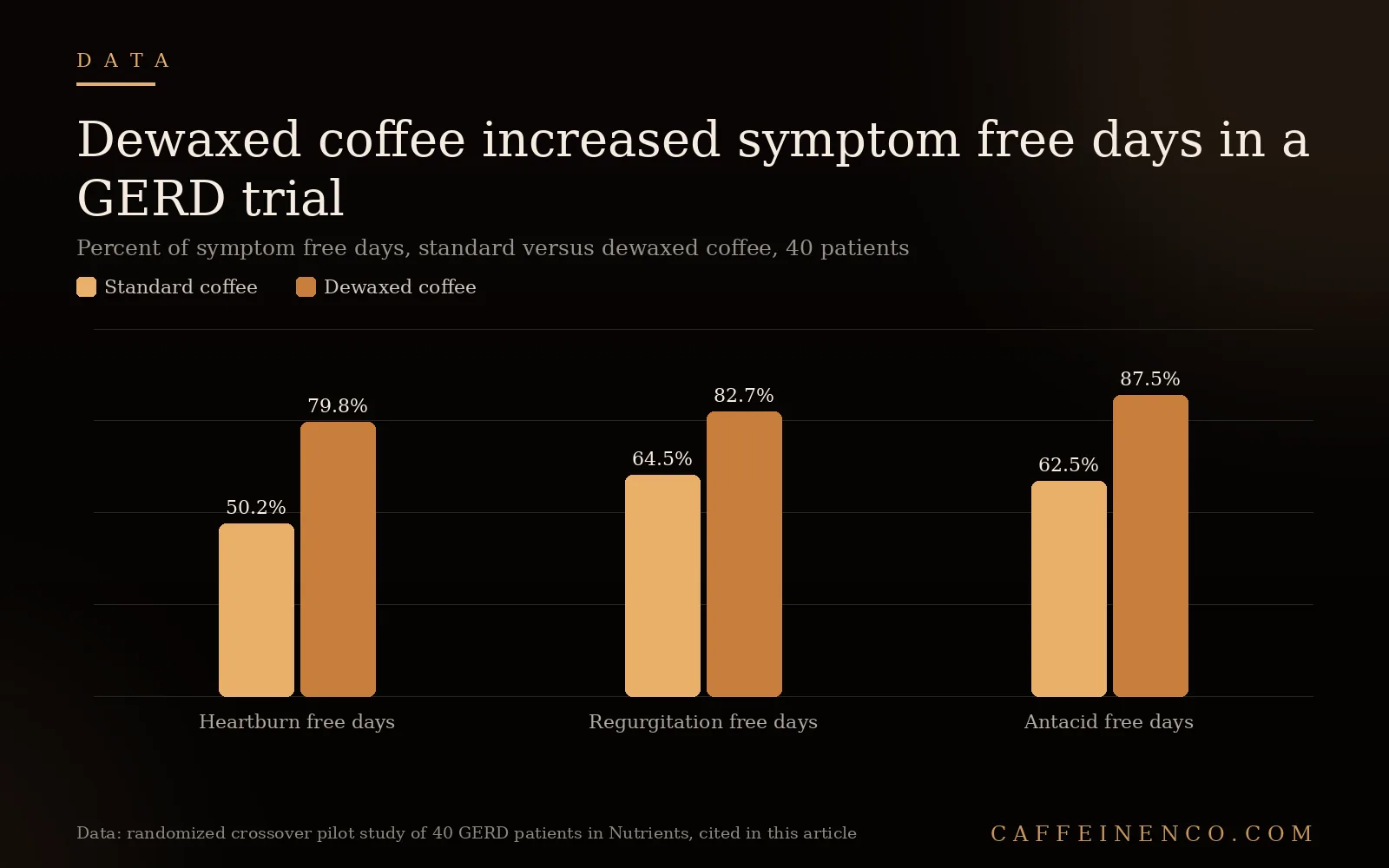
A newer, more specialized option worth knowing about, even though it is not yet a mainstream commercial category, is dewaxed coffee: beans processed to remove the natural wax layer on the bean surface along with some of the compounds that irritate the esophagus. A randomized crossover pilot study of 40 Italian GERD patients, published in the peer-reviewed nutrition journal Nutrients, had each participant drink standard coffee for two weeks and dewaxed coffee for two weeks, separated by a washout period. The results favored dewaxed coffee by a wide margin: heartburn-free days rose from 50.18% on standard coffee to 79.82% on dewaxed coffee, regurgitation-free days rose from 64.46% to 82.68%, and antacid-free days rose from 62.5% to 87.5%, all statistically significant differences within the same 40 patients.
| Measure | Standard coffee | Dewaxed coffee |
|---|---|---|
| Heartburn-free days | 50.18% | 79.82% |
| Regurgitation-free days | 64.46% | 82.68% |
| Antacid-free days | 62.5% | 87.5% |
Data: randomized crossover pilot study, 40 GERD patients, cited in this article.
The catch is availability. Dewaxed coffee is not a roast level or a brewing method you can ask for at a normal cafe or pick off a normal grocery shelf, it is a specialized processing step that the study’s authors themselves described as needing larger trials before it becomes a mainstream recommendation. It belongs on this page as evidence that the reflux-triggering compounds in coffee are specific and physically removable, not as a product anyone should expect to find easily today.
Worked example: building a lower-reflux coffee routine
- Start by tracking your own pattern for a week, not by assuming. Czerwony’s own guidance is to connect specific symptoms to what you drank beforehand rather than eliminating coffee on principle; note the roast, the brew method, the volume, and whether symptoms followed within an hour or two.
- If regular coffee is a clear trigger, try a darker roast before cutting coffee entirely. Cleveland Clinic’s own explanation, that longer roasting breaks down more of the beans’ natural acids, means a dark roast is a real, mechanism-backed first change, not a placebo swap.
- If a paper-filtered brew is not already your method, switch to one. A drip machine or pour-over dripper using a paper filter traps more of the oils that add to stomach irritation than an unfiltered method does. A straightforward paper-filter drip machine from 1st in Coffee’s coffee maker range covers this without any guesswork, or you can browse the same category on Amazon.
- If symptoms persist after the roast and brew-method changes, move to decaf rather than quitting outright. Per Czerwony, removing caffeine addresses the LES-relaxation half of the mechanism directly, even though the acid-related half remains. A dedicated decaf coffee selection from 1st in Coffee is a reasonable next step, or the same category on Amazon.
- Cut portion size and temperature before cutting coffee itself. Cleveland Clinic names both large volume and very hot temperature as independent aggravating factors, separate from acid and caffeine, so a smaller, cooler cup is a real lever even before changing roast, brew method, or caffeine content.
- If none of the above meaningfully changes your symptoms, treat it as a signal worth bringing to a doctor, particularly if you are in the roughly 1 in 5 US adults Cleveland Clinic describes as living with GERD, since persistent symptoms despite these changes point toward a mechanism beyond what diet adjustments alone can fix.
Common mistakes
Treating “coffee causes acid reflux” as a universal yes-or-no fact is the most common mistake; Cleveland Clinic’s own guidance is that trigger foods are individualized, and the LES-relaxation mechanism, while real and well documented, does not produce identical symptoms in every drinker. Assuming a roast-level switch solves the whole problem is the second mistake; darker roasts are measurably less acidic, per Cleveland Clinic, but they still contain caffeine, the compound most directly tied to loosening the LES. Assuming cold brew’s lower acidity comes from a lower pH is the third mistake; Rao and Fuller’s 2018 measurements found cold brew and hot brew pH values nearly identical, the real difference was in total titratable acid, a related but distinct measurement. Assuming decaf removes all reflux risk is the fourth mistake; the acids and oils beyond caffeine remain in the cup, so decaf can still cause or worsen heartburn for some drinkers, just typically less than regular coffee.
Common questions
Does coffee definitely cause acid reflux? Not for everyone, but the mechanism is real: caffeine can loosen the lower esophageal sphincter and coffee can increase stomach acid production, per Cleveland Clinic. Whether that produces noticeable symptoms in you specifically is individual, not universal.
Is dark roast coffee actually better for acid reflux? Partially. Cleveland Clinic states darker roasts are less acidic because longer roasting breaks down more of the beans’ natural acids, which helps with the acid-production side of the mechanism. It does nothing about the LES-relaxation effect of the caffeine that remains in a dark roast.
Is cold brew coffee actually less acidic? Its pH is nearly identical to hot brew, per a 2018 Scientific Reports study, but it does contain meaningfully less total acid by volume. Both measurements matter differently: pH did not separate the two methods in that study, total titratable acid did.
Does decaf coffee still cause heartburn? It can, for some people, though typically less than regular coffee. Removing caffeine reduces the LES-relaxation effect directly, but the natural acids and oils that also irritate the stomach lining are still present in decaf.
How common is GERD, and does that change how seriously I should take coffee-triggered symptoms? GERD affects roughly 1 in 5 people in the United States, per Cleveland Clinic. Occasional heartburn after coffee is common and often manageable with the diet and brewing changes covered above; frequent or severe symptoms are worth discussing with a doctor rather than managing through trial and error alone.
What is dewaxed coffee, and is it worth seeking out? A specialized processing method that removes the natural wax layer and some irritating compounds from coffee beans. A small 40-patient pilot study found real symptom improvement, heartburn-free days rising from about 50% to about 80%, but it is not yet a mainstream commercial product, and the study’s own authors called for larger trials before it becomes a general recommendation.
For more sourced breakdowns like this one, delivered weekly, subscribe to The Sunday Pour.
Sources & data
- Cleveland Clinic: Does Coffee Cause Acid Reflux?
- Cleveland Clinic: Acid Reflux and GERD
- Cleveland Clinic: GERD Diet, Foods to Eat and Avoid
- Scientific Reports: Acidity and Antioxidant Activity of Cold Brew Coffee (Rao and Fuller, 2018)
- PMC: Effect of Dewaxed Coffee on Gastroesophageal Symptoms in Patients with GERD, a Randomized Pilot Study